
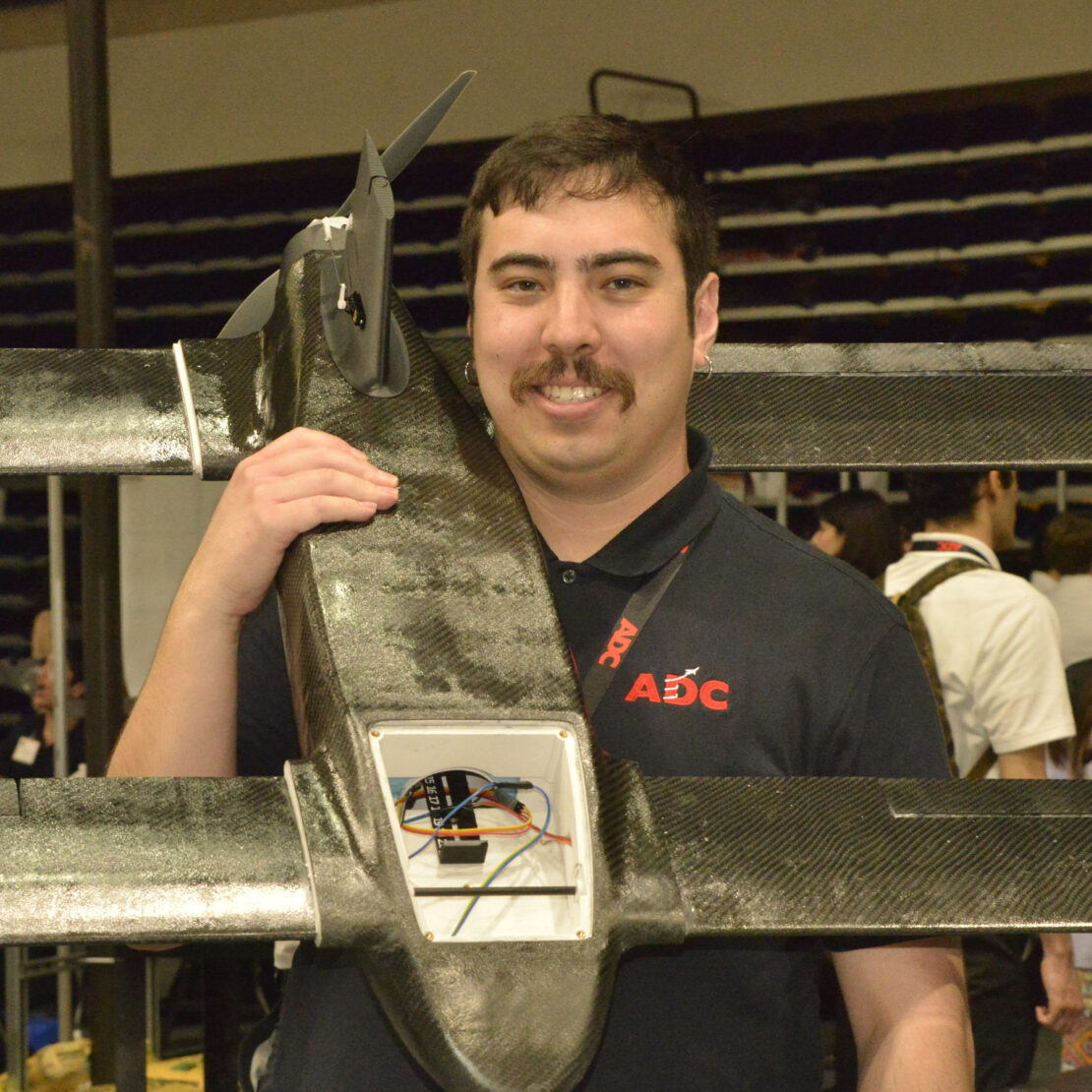
Reese Bookout
Co-Founder of American Drone Company
2025 TBHF Future Texas Business Legend Award Recipient
2026 Graduate of The University of Texas at San Antonio’s Klesse College of Engineering & Integrated Design
Founder Feature: Reese Bookout and the Future of Flight
At 26 years old, Reese Bookout is tackling some of the biggest challenges in unmanned aviation: Beyond Visual Line of Sight operations and Endurance. This month, the engineering student graduates with a degree from the Klesse College of Engineering & Integrated Design at The University of Texas at San Antonio — and is leaving with a patent-pending drone technology that could reshape how aerial surveying, mapping, and remote sensing is done across Texas and beyond.
Bookout is the co-founder of American Drone Company (ADC) alongside fellow entrepreneur Isaiah De La O. Together, they are working on developing UAV platforms aimed towards the future of commercial unmanned aviation – Beyond Visual Line of Sight.
“The traditional drone model is broken,” Bookout explains. “One pilot, one drone doesn’t scale.”
American Drone Company is building a new operational model centered around regional “Command Hubs” that deploy fixed-wing UAVs capable of autonomous remote sensing across the Texas I-35 corridor. Instead of pilots operating drones on-site from the field, the company envisions centralized systems controlling UAVs remotely, and continuously collecting high-value data for infrastructure, land surveying, environmental monitoring, and public safety applications. Their goal is to become the natural solution for companies looking to replace their foreign-made fleet while reducing operating costs.
Recent restrictions on DJI imports and growing concerns over foreign-manufactured UAVs are pushing companies toward higher-cost American alternatives. The new “Command Hub” model enables ADC to support the market without forcing a costly hardware transition. Bookout says ADC intentionally positioned itself early by sourcing NDAA-compliant components and developing relationships with American suppliers and distributors. Additionally, their Hardware-as-a-Service model enables companies to lower operating costs by reducing fleet maintenance requirements and reallocating drone operators to higher-value work.
What makes their technology especially compelling is the team’s innovative “thermal recharge loop” — the navigation technique that will enable endurance UAV operations. Inspired by biomimicry and the soaring techniques used by birds, the drone identifies naturally occurring thermal columns (rising pockets of warm air) and uses them to gain lift and altitude at virtually no energy cost. A thermal camera onboard detects and geotags these atmospheric thermals, allowing the aircraft to climb, glide, and conserve power during flight.
Combined with solar panels integrated into the drone’s tandem-wing design, the technology could ultimately allow UAVs to remain airborne for extraordinarily long durations.
The aircraft itself is equally ambitious: an 11-foot wingspan, dual-wing fixed-wing platform built from foam and carbon fiber composites, designed to disassemble compactly into a truck bed for easy transport. The drone’s lightweight structure, aerodynamic efficiency, and autonomous sensing systems were recently showcased at UTSA’s 2026 Tech Symposium, where American Drone Company entered projects in three separate engineering categories:
- Thermal Soaring Endurance UAV
- Electronics, Control, and Thermal Detection System
- Launcher for Endurance UAV
The multidisciplinary project brought together 13 UTSA engineering students across aerospace, electrical, computer, and mechanical engineering disciplines. Five students focused on the launcher system, five on UAV development, and three on electronics and software integration. Over the past nine months, the team has conducted intensive research and development to bring the full-scale prototype to life.
Bookout credits much of the project’s momentum to the entrepreneurial ecosystem around him. A 2025 Future Texas Business Legend award recipient, he used his TBHF prize money to self-fund the prototype and recruit top engineering talent from UTSA’s senior design program. He is also leveraging the TBHF Alumni network by participating in an Executive Leadership Group (ELG), where fellow entrepreneurs encouraged him to establish a Science Advisory Board as the company prepares for future fundraising and commercialization.
While the company is still in its pre-seed phase, the long-term vision is expansive. In addition to remote sensing, future applications for the technology could include wildfire prevention, search-and-rescue operations, environmental monitoring, communications infrastructure support, and AI-assisted subsurface analysis.
For Bookout, the mission is larger than simply building a better drone. It is about redefining what autonomous flight can achieve.